
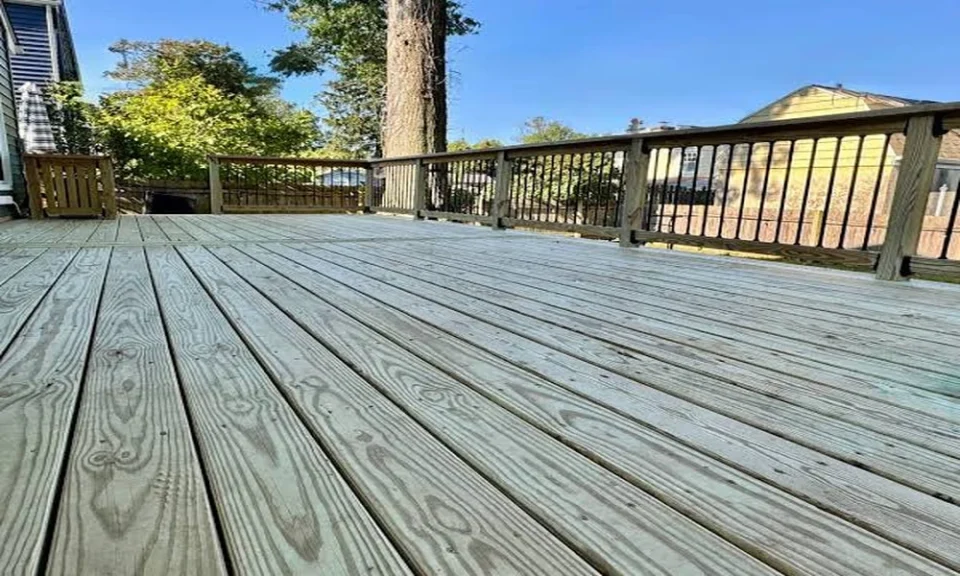
Fall is one of the two best seasons for staining exterior wood, and in central Georgia it may be the better of the two. Spring brings mild temperatures, but it also brings the yellow haze of pine pollen that settles into wet stain and dries there permanently. By October, the pollen is gone, the worst humidity has passed, and daytime temperatures usually sit comfortably inside the range most stain makers print on the can.
Good weather only gets you started. Most early stain failures, like peeling, blotchy color and graying within a year, come from preparation decisions made before anyone opens a can. The seven checks below cover what decides whether a deck or fence finish lasts two seasons or five.
If you’d rather leave the prep and application to a crew, Byron Painting Company stains decks and fences across Byron, Perry, Warner Robins and Macon. The same team also paints interiors and exteriors, repairs drywall, and removes or reapplies ceiling texture, so outdoor wood and indoor projects can go on one schedule for residential or commercial properties. Fall calendars fill as homeowners rush to finish before winter, so requesting an estimate while the dry weather lasts is the easiest way to get a convenient start date.
1. The weather window, hour by hour
Most deck stains are meant to go on between roughly 50°F and 90°F, but the daily high doesn’t tell the whole story. Fall mornings bring heavy dew that can leave boards damp until mid morning, and evening dew can land on stain that hasn’t cured yet. The practical window is late morning through early afternoon, on a day with no rain in the forecast and calm wind.
Direct sun is the other trap. A dark board in full sun can get much hotter than the air around it, and stain flash dries on hot wood before it soaks in, leaving lap marks and a weak surface film. Working with the shade as it moves across the deck solves most of this. Falling leaves matter too, because wet leaves on fresh stain can leave tannin marks that look like dark shadows.
2. How dry the wood really is
Stain manufacturers generally want wood moisture content at or below about 15 percent. A basic pin moisture meter checks this in seconds, and it’s worth testing several boards, including any in shade or near downspouts, since those dry last.
Without a meter, the water drop test is a decent stand in. Sprinkle a little water on the boards. If it soaks in within a few minutes, the wood can absorb stain. If it beads or sits on top, the wood is either still wet or sealed by an old coating. After a wash, most decks need two or three dry days before they’re ready.
3. Whether new lumber has had time to dry
Freshly built decks are the most common case where people stain too soon. Pressure treated lumber leaves the plant saturated with waterborne preservative, and the Treated Wood Council notes that treated wood is typically ready for finishing about 60 days after installation. Sun exposure, weather and how long the lumber sat at the yard can all shift that timing.
Staining wet treated wood traps moisture under the finish, which leads to poor penetration, early peeling and sometimes mildew underneath the coating. A deck built in late summer may be ready by mid fall. One built in October may need to wait until spring.
4. A cleaning step that goes past the pressure washer
Blowing off leaves isn’t cleaning. Gray, weathered wood has a layer of dead fibers on top that stain sticks to poorly, and mildew left behind will keep growing under fresh pigment. A dedicated deck cleaner, often based on sodium percarbonate, loosens that layer and kills surface growth.
Pressure washing can help on rough, older decks, but too much pressure or a narrow tip at close range tears up the grain and leaves a fuzzy surface. After washing, a wood brightener restores the wood’s pH and evens out color, and a light sanding knocks down any raised fibers so the stain soaks in evenly.
5. What is already on the boards
The existing finish limits your choices. A semi-transparent stain can go over bare wood or a worn semi-transparent coat, but it can’t go over a solid stain or paint and still look translucent. Switching from solid back to semi-transparent means stripping the old coating completely.
Product chemistry matters too. Some oil based and water based stains don’t bond well over each other, so check the label or test on a small, hidden spot like the back of a step. If the new coat beads or stays tacky there, it will fail on the rest of the deck.
6. The right amount of pigment for each surface
Stains range from clear to semi-transparent to solid. More pigment blocks more UV, so a clear sealer may need recoating every year while a semi-transparent stain lasts noticeably longer. Solid stain hides grain and mismatched boards but behaves more like paint, so on walking surfaces it tends to wear through in traffic paths and can peel.
Horizontal and vertical wood wear at different rates. Deck floors take direct sun, pooling water and foot traffic, while railings and fence pickets mostly face weather from the side. Many people use a semi-transparent stain on the floor and a slightly heavier stain on railings or fences, accepting that the floor will need attention first.
7. Repairs that should come before any finish
Stain doesn’t fix soft wood. Press a screwdriver into suspect boards, especially near stairs, planters and the ends of joists. If it sinks in easily, that board needs to be replaced, not coated. Raised nail heads should be set or replaced with screws, and cracked or cupped boards will stand out more once stained.
Fences need a separate check. The bottoms of pickets that sit close to soil or mulch, and sections hit by lawn sprinklers every morning, often rot years before the rest of the fence. Trimming back vegetation, raising the bottom edge if possible, and redirecting sprinkler heads protects the new finish as much as the stain does.
When all seven boxes are checked, the actual staining takes the least time of the whole project. Two thin coats applied wet on wet, brushed into the grain and kept off hot, sunny boards, will outlast a single heavy coat every time.
