
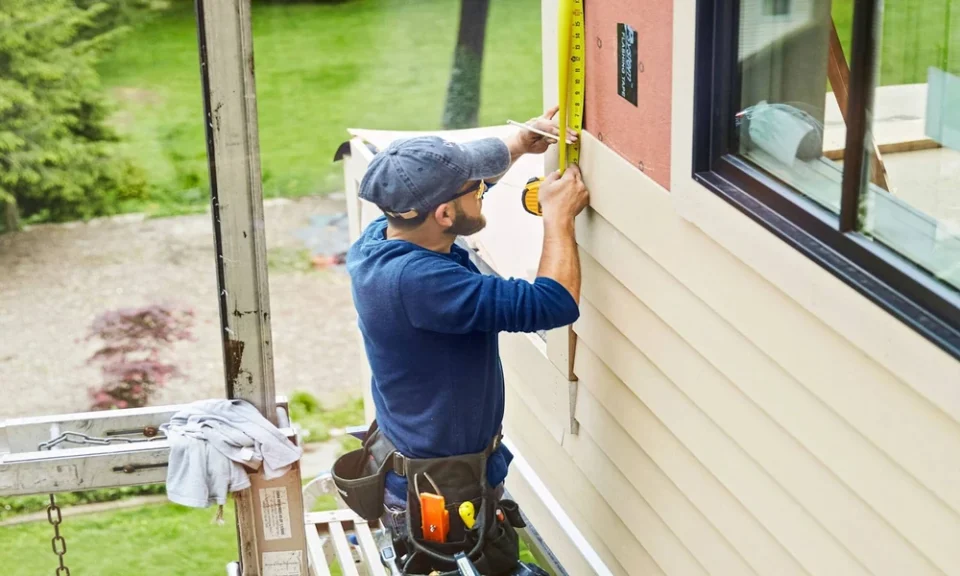
Siding problems rarely show up with a big, obvious announcement. They creep in. A loose panel after a wind event. A soft spot near a downspout. A seam that looks a little “off.” Most homeowners start with the same question: should I do a siding repair or is it time to replace more of the exterior? The hard part is not finding a fix. The hard part is knowing when repairs stop making financial sense.
Contractors sometimes call this siding “breakpoint.” It is the moment when you can still repair the issue, but you should not, because the total cost and risk of chasing damage is higher than solving it once.
This article breaks down how to spot that breakpoint, what factors push you toward replacement, and how to make the decision based on cost-effectiveness instead of stress.
What “cost-effective” really means with siding
Cost-effective is not just the lowest invoice today. With siding, cost-effectiveness includes:
- How long the fix lasts before you pay again
- Whether the problem is isolated or spreading
- How much hidden damage you are risking behind the cladding
- How the repair affects energy use (air leaks, moisture, missing insulation)
- How difficult it is to match materials (and whether mismatches hurt resale)
- Opportunity cost, meaning the time and money you spend coordinating repeat visits
A small repair can be smart even on an older home if it buys you several years without creating new risks. A repair can also be a money pit if it keeps failing because the underlying system is compromised.
The siding “breakpoint” in one sentence
You have reached the siding repair vs replace breakpoint when the next repair is likely to be followed by another repair soon, either because the siding is at the end of its service life or because the real problem is underneath it.
That breakpoint is rarely triggered by one factor. It is usually a combination of age, moisture, installation details, and repeated failure points.
9 signs you are nearing (or past) the breakpoint
1. You are repairing the same area more than once
If the same corner keeps loosening, the same seam keeps opening, or the same section keeps showing moisture staining, the siding is signaling that the underlying cause is still active. Common culprits include:
- Improper flashing at roof-to-wall transitions
- Missing or poorly integrated water-resistive barrier
- Repeated wetting from gutters or splashback
- Movement from temperature swings that the installation did not allow for
A repeat repair can be the most expensive kind, because you pay for teardown and labor again without gaining long-term stability.
2. Damage is not truly isolated
A single cracked panel from impact is a straightforward repair. The breakpoint gets closer when “one issue” is attached to a pattern, such as:
- Multiple cracked panels on more than one elevation
- Warping or buckling across long runs
- Several loose courses after moderate winds
- Trim failures around multiple windows or doors
When the same symptom shows up in multiple locations, you may be looking at aging material, installation problems, or moisture management issues.
3. You see soft sheathing, swelling, or rot clues
Siding is a rain screen and a shield, not a waterproof box. If water is getting behind it and staying there, the structure can be at risk. Warning signs include:
- Soft spots when gently pressed (do not poke holes, just observe)
- Bubbling paint on nearby trim
- Swollen OSB edges where visible
- Persistent musty odors near exterior walls
- Interior stains that line up with exterior transitions
If sheathing damage is present, you may still “repair” siding, but the work starts to resemble partial replacement with carpentry and water management upgrades. That is a common breakpoint trigger.
4. The repair requires dismantling a large section anyway
Some siding types lock together. To replace a piece in the middle, you may have to remove multiple courses above and around it. The labor can quickly exceed what homeowners expect from a “small repair.”
If a repair requires extensive unzipping, removing trim, or disturbing window and door details, you should at least price a larger scope. Many times, the cost difference between “repair” and “replace this wall” is smaller than you think.
5. Material matching is difficult or impossible
This is not vanity. Matching matters for resale and for avoiding a patchwork look that can make a home seem poorly maintained.
Matching becomes difficult when:
- The color is discontinued
- The profile or texture has changed over the years
- Sun exposure has faded existing siding
- The original product line has been replaced by a new series
When matching is unlikely, cost-effectiveness shifts. You are paying for a repair that can reduce curb appeal and still does not address broader aging issues.
6. Your utility bills and comfort problems point to envelope issues
Siding itself is not insulation, but it is part of the building envelope. If you feel drafts, have uneven room temperatures, or notice higher energy use, your exterior walls may be leaking air or holding moisture.
A repair might correct a local hole or gap, but widespread comfort issues often indicate that replacement, paired with correct air and water control layers, will deliver better value.
7. You have widespread caulk dependence
Caulk is a tool, not a structural system. If your exterior relies on heavy caulking at seams, joints, and transitions because details were not built to shed water properly, repairs become a cycle.
Repeated caulking and spot sealing can trap moisture behind siding, especially if water is entering higher up. If “just caulk it” has become a routine maintenance plan, you may be at the breakpoint.
8. Multiple failure points around windows and doors
Openings are complex. When you see repeated problems around several windows and doors, repairs can become whack-a-mole. These issues may suggest:
- Missing head flashing or drip cap
- Incorrect integration of flashing tape
- Improper kickout flashing where rooflines meet walls
- Poor trim detailing that channels water behind the cladding
At that stage, replacement can be more cost-effective because it allows systematic correction of flashing and water management details.
9. The siding is at or beyond typical service life for its condition
Service life is not a magic number, but age matters. A well-installed system in a mild environment can last longer. A poorly detailed system in harsh conditions can fail early. If your siding is old enough that it is brittle, chalking heavily, or cracking easily, repairs often become fragile and temporary.
A practical way to calculate the breakpoint: the “3-bucket” method
When deciding repair vs replace, gather the project into three buckets and compare totals.
Bucket 1: Direct repair cost
- Labor to remove and replace damaged pieces
- Disposal
- Trim work required to access the area
- Paint or finishing, if applicable
Bucket 2: Hidden risk cost (the hard one)
You cannot always price this perfectly upfront, but you can estimate risk based on symptoms.
- Likelihood of damaged sheathing or framing
- Likelihood of mold remediation
- Likelihood of recurring water entry
- Risk of repair revealing a larger problem later
If moisture is suspected, hidden risk cost rises quickly.
Bucket 3: Opportunity cost
- Time off work for repeat visits
- Temporary solutions (tarps, dehumidifiers)
- Future repairs you are likely to need within 1 to 3 years
Now compare two scenarios:
- Repair now + likely follow-up costs
- Replacement scope that solves the system problem once
When scenario 1 starts approaching scenario 2 in total expected cost, you have hit the breakpoint.
When repairs are usually the right call
Repairs often make sense when:
- Damage is clearly isolated (impact crack, single loose panel)
- The underlying sheathing feels solid and shows no moisture signs
- Matching material is available or the location is low-visibility
- The siding system is otherwise performing well
- The repair does not require disturbing complex flashing details
A good repair also includes finding the “why.” If the contractor cannot explain why the panel failed or why water got in, be cautious. The best repair is one that prevents the next repair.
When replacement is usually the smarter investment
Replacement tends to be more cost-effective when:
- You have multiple elevations showing symptoms
- The siding is brittle, heavily faded, or cracking in several areas
- There is evidence of sheathing deterioration or trapped moisture
- Window and door detailing is repeatedly failing
- You need frequent resealing or patching to keep water out
- You want a consistent exterior appearance and predictable maintenance
Replacement is not just new cladding. The value comes from rebuilding the exterior wall system correctly: water shedding, drying potential, airflow where appropriate, and properly integrated flashing.
Common “breakpoint accelerators” homeowners overlook
Poor drainage at the roofline
Overflowing gutters, short downspouts, and missing kickout flashing can concentrate water on siding. You can repair siding forever, but if water keeps being dumped in the same spot, it will fail again.
Ground contact and splashback
Siding too close to grade, mulch piled high, or hardscapes that bounce water back onto walls can saturate lower sections. If the bottom edge keeps deteriorating, address clearance and drainage along with any repair.
Mixed materials and transitions
Transitions between siding types, or between siding and masonry, are frequent weak points. If multiple transitions are leaking or deteriorating, replacement with better detailing may be the cost-effective move.
Questions to ask before you decide
Use these to keep the conversation practical and non-emotional:
- Is the damage cosmetic, functional, or structural? Cosmetic issues can wait. Functional and structural issues should not.
- What caused the damage? Impact, wind, water, UV, installation detail, or movement.
- How confident are we that the wall behind the siding is dry and intact? If confidence is low, consider opening the area for inspection.
- How much siding must be removed to do the repair correctly? Access drives labor cost.
- How likely is a match? If the repair will stand out, does that matter for you?
- If we repair today, what is the next likely failure point? A good contractor can predict this based on the system.
- What is the lifespan of the remaining siding if we fix this section? If most of it is near end-of-life, replacement can be more logical.
The bottom line
A repair is cost-effective when it stops the problem, not when it simply hides it. The breakpoint arrives when the siding system is telling you, through repeated failures or moisture clues, that you are no longer dealing with a single damaged piece. You are dealing with a performance issue.
If you are unsure, make the decision based on scope and risk, not labels. “Repair” and “replace” are just words. What matters is whether the work fixes the underlying cause, protects the wall assembly, and saves you from paying twice.
If you’d like, I can also adapt this into a slightly more contractor-facing version for a construction audience (less homeowner tone, more field cues), or generate a shorter 800 to 900 word version for sites that prefer leaner guest posts.
